Year:
2025
Focus:
Data Viz
For:
Coursework
OVERVIEW
Translating the Private Vulnerability of Our Daily Search Inputs into a Collective Narrative Archive
Once, people looked to the stars for answers. Now, millions of mobile screens light up at once; instead of constellations, we follow search results, and instead of seasons, we follow algorithms. Technology has transformed into an emotional mirror that actively mediates personal care, provides instant validation, and anchors quiet introspection. Search Index is an interactive, web-based scrollytelling piece blending human data, written narrative, and choice-driven reflection designed for solitary, deeply personal moments. By analyzing the quiet digital rituals we execute inside search boxes, the project shifts our understanding of technical systems—recontextualizing automated interfaces from cold, isolating data logs into a shared, communal space for collective human care.

PROBLEM
The Fragmented Reassurance of Frictionless, Automated Companionship
In moments of acute uncertainty, anxiety, or loneliness, human attention often feels scarce and emotional vulnerability feels incredibly risky. To avoid social friction, millions turn to search engines and AI chatbots before turning to their physical networks, seeking an immediate interface that feels entirely safe and nonjudgmental. However, this relief is inherently temporary. While commercial tech organizations push an aggressive "AI will solve loneliness" narrative, users ultimately leave their screens feeling momentarily calmer but profoundly unknown. The true danger is that opaque, frictionless machine workflows strip away user agency, trapping vulnerable individuals inside corporate loops of "algorithmic intimacy" where deep-seated human longing is processed by predictive models optimized for engagement rather than genuine empathy.

SNEAKPEEK
What do you think we’re all searching for underneath the keywords?
USER INTERVIEWS
Documenting the Psychological Mechanics of Compensatory Control and Digital Shifting
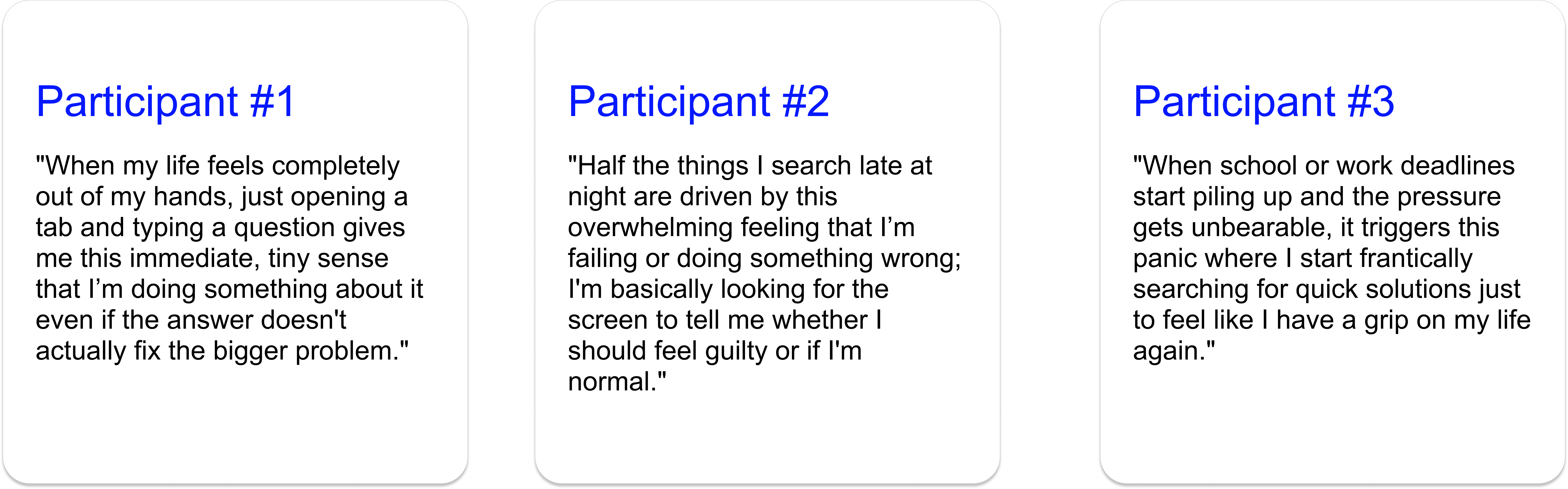
Primary research involved qualitative deep-dive interviews with 27 individuals alongside targeted surveys investigating modern digital coping habits and real search logs. The qualitative data revealed that these isolated rituals are driven by a distinct psychological mechanic: compensatory control. When environmental uncertainty spikes, small, immediate digital actions—like typing a query—help users restore a fleeting sense of internal order, a behavior amplified by the internet's convenience culture. Furthermore, 48% of participants noted their emotional searches were deeply bound to feelings of guilt or self-criticism, while 40% cited an urgent desire to regain control or navigate immense external pressures from school or labor environments.
COMPETITIVE ANALYSIS
Critiquing Opaque Corporate Walled Gardens Against Humanistic Data Frameworks
The project mapped the emerging ecosystem of digital mental health proxies against critical, creative, and historical precedents to evaluate interaction patterns:
The Rise of r/therapyGPT & AI Chatbots: Explorations into public forums revealed an expanding reliance on chatbots due to their affordability, memory retention, and automated validation. This is supported by macro trends: 2025 data indicates therapy has become a leading use case for AI chatbots, with 34% of adults using them for emotional support, and 40% of young adults defaulting to the internet before humans when anxious.
Data Humanism Frameworks (Giorgia Lupi) & Whose AI? (Carrie Wang): Utilizing design models that approach data as a deeply expressive, beautifully imperfect human material layer rather than a cold metric to abstract.
Narrative Scrollytelling Precedents (Alvin Chang / The Pudding): Evaluating highly intimate web experiences that seamlessly weave rich, qualitative human data into compelling visual narratives.

AFFINITY MAPPING
Clustering the Human Nuances Behind Algorithmic Intimacy
Synthesizing primary interview transcripts, forum sentiment classification, and behavioral research surfaced three foundational thematic clusters:

TARGET USER
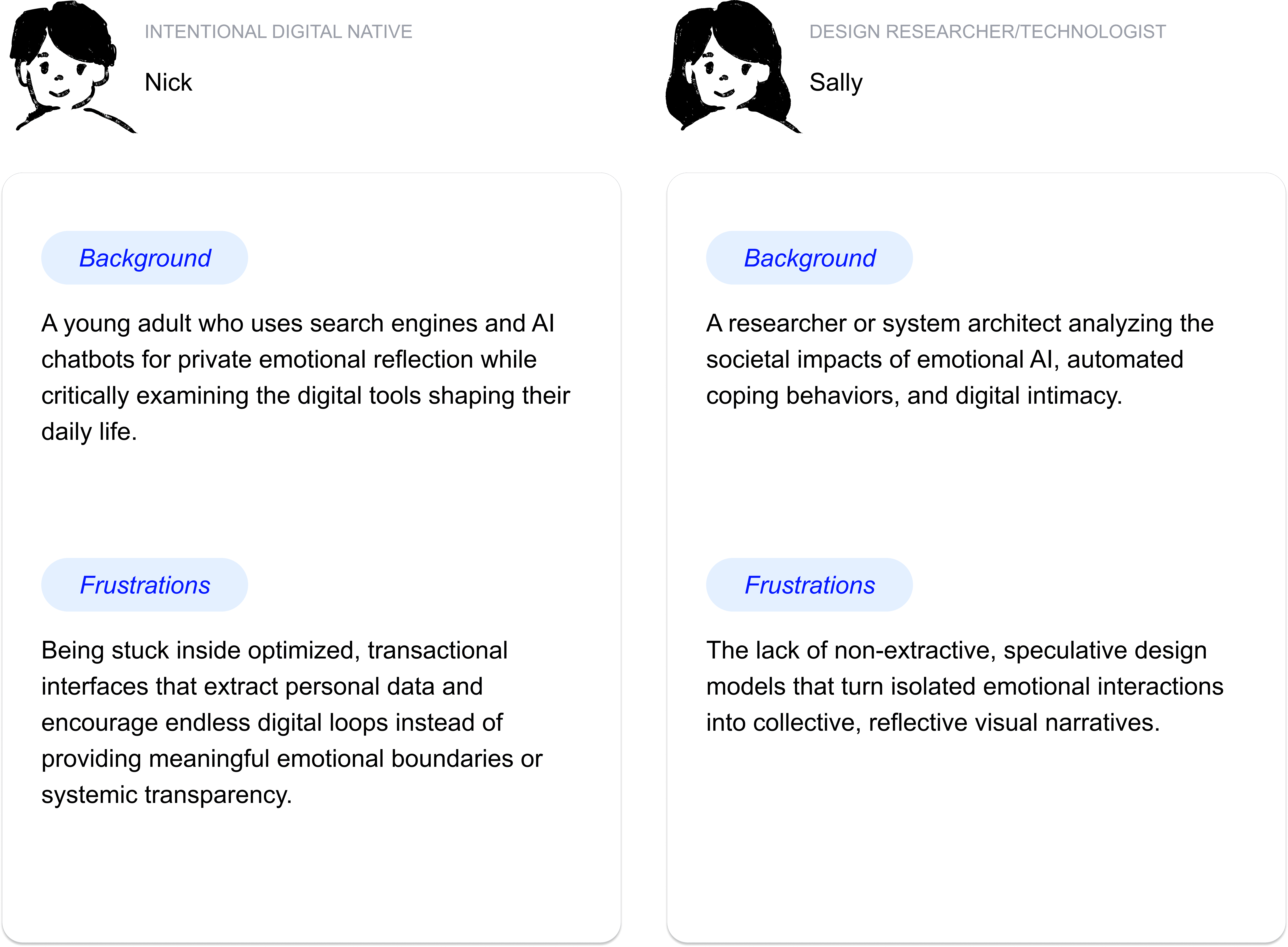
Engaging Critical Technical Navigators and Emotional AI Researchers
The service structure was engineered to directly address the goals of two primary stakeholders:
LOW-PROTOTYPING
Shifting from an Abstract Wandering Interface to a Rooted Storytelling Grid
The project's early iterative cycles focused entirely on designing an open, unstructured exploration canvas meant to replicate the sprawling, wandering path of natural internet searching. However, user testing quickly exposed major interaction flaws: the interface was excessively abstract, causing participants to lose focus without a clear narrative anchor. This phase proved that open data environments require a deliberate structural spine to give personal user choices any real emotional weight. This low-fidelity failure drove the critical design pivot to merge interactive search metrics with an intimate, highly structured scrollytelling path.

THE VISION
Reclaiming Algorithmic Infrastructure as a Vehicle for Shared Connection
The ultimate vision of Searching for Care is to craft an ambient digital space that dismantles the isolation and stigma of online vulnerability. Rather than asking how technology can replace human care, the project reframes emotional searching as a collective, visible ritual of care seeking. By shifting the focus away from automated algorithmic generation and prioritizing scratch-built human storytelling, the experience transforms highly isolated queries into an open, validating communal canvas.


KEY ITERATIONS
Enforcing Intentional Production Constraints to Protect Narrative Authenticity
The interface advanced through distinct technical and conceptual modifications based on active user feedback:


Guided Introspective Reflection Gates
Before encountering any dense narrative text, users engage with a sequence of quiet, beautifully framed guiding questions. This interactive gate slows down the rapid pace of standard web browsing, establishing a respectful, deeply introspective mood that preps the user for an intentional, self-paced exploration.
Participatory Research Scrollytelling & Mapping
Built entirely from scratch using p5.js, the web interface guides users through a rich interactive narrative exploring the psychology of tech intimacy. As users move through the piece, they answer the exact questions asked to the original 27 research participants, instantly mapping their private answers against real, historical data to visualize how their internal emotions relate to the broader community.
The Introspective Journey Ticket Handoff
To bridge the digital experience back to the physical world, the journey culminates in a custom, personalized visual ticket. The ticket displays their precise completion time and their response to the final question, paired with a small, elegant prompt that directly encourages the user to step away from their browser and pursue a human connection beyond the screen.
USER TESTING
Validating Emotional Agency via Human-Centered Micro-Interactions
High-fidelity testing proved that the scratch-built p5.js scrollytelling architecture effectively resolved the narrative detachment of early versions. Testers reported that reviewing their own search habits alongside anonymous community outputs felt profoundly validating rather than diagnostic or clinical. By introducing purposeful interactive friction—such as deliberate confirmation steps and quiet reading pauses—the interface successfully served as an emotional mirror, allowing users to analyze their relationship with technology with absolute dignity.


OUTCOME
An Intimate Counter-Artifact Defending Raw Human Storytelling Over Automation
The execution of Searching for Care delivered a fully interactive web experience that successfully reframes emotional searching as an act of shared humanity. By choosing code-level constraint over automated technical spectacle, the project serves as a powerful counter-artifact to frictionless enterprise optimization. The resulting piece demonstrates that our most vulnerable digital habits can be creatively restructured into supportive platforms for mutual connection, providing a proven, human-centered blueprint for future introspective design systems.
