Year:
2025
Focus:
Product Design
For:
Start-up / IEI Fellowship
OVERVIEW
Building an Emotionally Supportive Bridge for the Digital Immigrant Generation
For the past thirty years, the digital landscape has been engineered around layered interfaces and hidden metaphors optimized for digital natives. For older adults, this environment can feel incredibly foreign and alienating. Stepwise is an education-first, device-agnostic, and privacy-respecting hybrid tech literacy program designed to act as a self-paced, gamified platform for older adults. By pairing an interactive digital experience with a tactile physical workbook, Stepwise reframes tech literacy as an emotional journey rather than a sterile skills transfer. The system enables seniors to navigate the modern digital systems shaping their health, finances, and independence on their own terms, entirely free of stigma.

PROBLEM
The Invisible Labor of Caregiving and the High Stakes of Digital Alienation
Modern software design increasingly prioritizes rapid, frictionless navigation, which inherently excludes age-related physical and cognitive shifts such as vision changes, memory load, and hand tremors. AARP research indicates that 64% of adults over the age of 50 feel technology was not designed with their age group in mind. This gap introduces severe vulnerabilities: older adults lost $4.9 billion to digital fraud and scams in 2024, making security an active source of daily anxiety. This technical exclusion creates a massive, invisible burden on family networks. In New York City, 30% of adults under 60 belong to the sandwich generation, caring for both a minor and an older adult, with family caregivers spending over 15 hours per week providing repetitive, informal tech support. While existing community programs exist, they require seniors to travel to one-off classes, leaving them completely unassisted in the exact moments they encounter digital systems alone.

SNEAKPEEK
A hybrid approach to learning, from lessons to peer workshops to AI assistance and more
USER INTERVIEWS
Evaluating AI Readiness and Guardrails with Global Infrastructure Operators
To build an evidence-based pedagogy, deep community research was conducted through qualitative interviews with older adults aged 67 to 84, family caregivers aged 38 to 55, and professional subject matter experts, including eldercare attorneys and directors at the Charles B. Wang Community Health Center. These conversations revealed that technology is no longer viewed as a mere convenience; it is seen as a major risk factor. Participants across all interviews expressed intense anxiety regarding AI-driven scams, voice cloning, deepfakes, and accidental account lockouts. The qualitative data inverted initial design assumptions, proving that internalized shame and the fear of making irreversible mistakes—not just a lack of interest—serve as the primary barriers preventing older adults from participating in the digital world.

COMPETITIVE ANALYSIS
Shifting from Reactive Hardware Simplification to Cross-Platform Skill Transfer
An evaluation of the aging tech ecosystem revealed distinct competitive gaps across existing models:
AARP Tech Help and Senior Planet: Offer high-volume community access but rely on inconsistent, high-level curricula that are slower to adapt to specialized topics like AI security.
GrandPad: Provides highly simplified senior hardware but traps users in a walled garden, failing to build transferable digital skills for real-world devices.
Apple Genius Bar: Delivers effective device-specific troubleshooting but lacks structured, cross-platform education and is not emotionally tailored to the pacing needs of seniors.
Stepwise occupies an entirely unoccupied market quadrant by operating as an education-first, software-driven, and device-agnostic partner that easily scales across existing smartphones, tablets, and voice assistants.

AFFINITY MAPPING
Synthesizing Community Testing into Core Pedagogical Design Principles
Consolidating insights from over a dozen expert interviews, focus groups, and community data collections surfaced four foundational thematic clusters that directly shaped the design architecture:

TARGET USER
Designing an Inclusive System Architecture for Interdependent Generations
The service ecosystem addresses the distinct, overlapping friction points of two core stakeholders:

LOW-PROTOTYPING
From an Autonomous Digital Assistant to a Hybrid Learning Blueprint
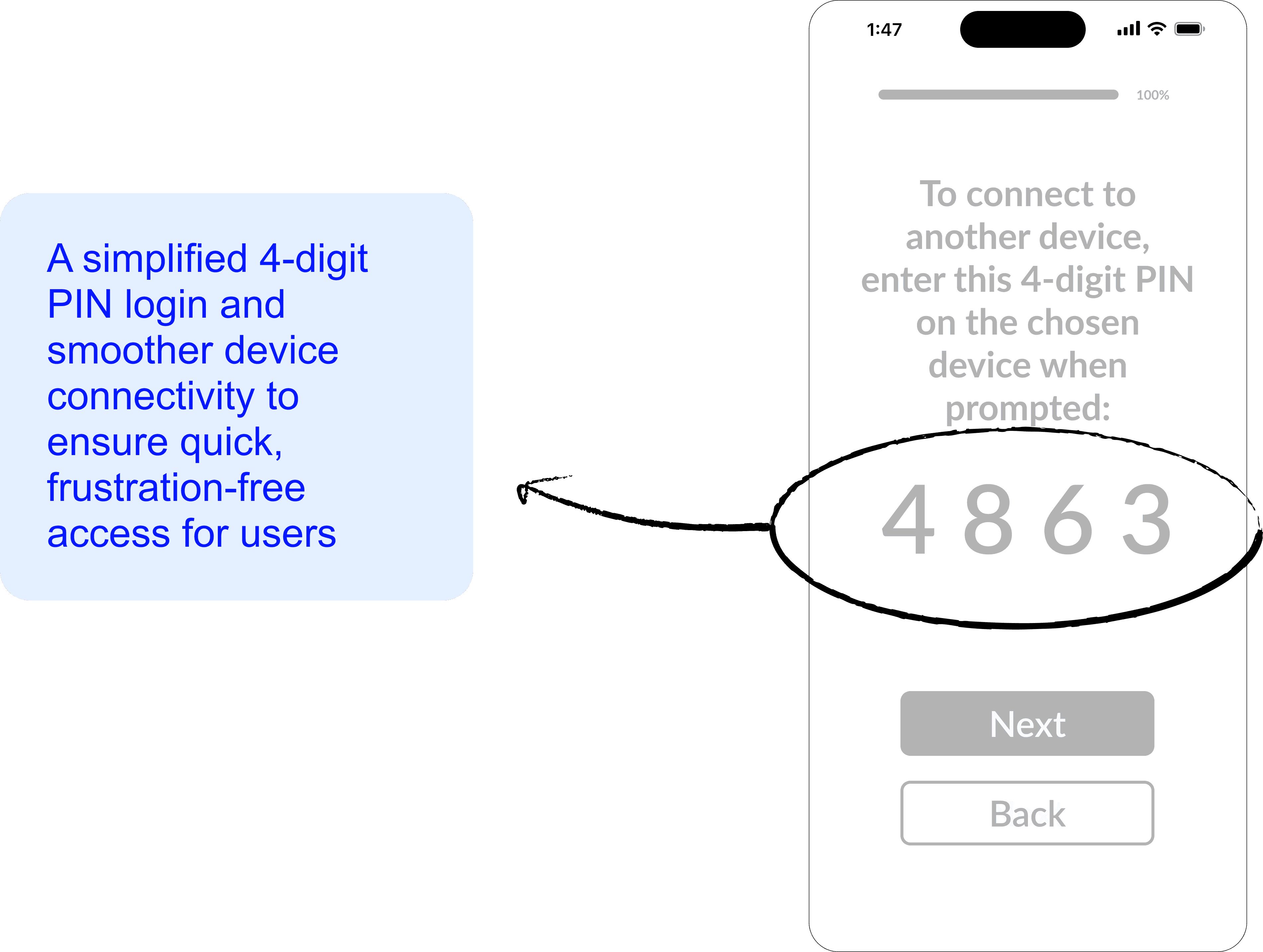
The initial product concept began as a purely digital solution centered around an agentic AI companion guiding users through every step on-screen. Low-fidelity testing with paper wireframes and basic digital click-throughs quickly exposed deep flaws in this single-channel approach. Users became overwhelmed by the AI interface itself, getting lost in the navigation before any real technical learning took place. This stage forced a critical structural pivot: shifting the baseline solution away from an elite digital agent toward a hybrid, multi-modal interface that grounds digital abstraction in comfortable, low-fidelity physical materials.


THE VISION
Achieving Digital Self-Sufficiency Without Stigma or Exclusion
The core vision of Stepwise is to create a world where every older adult can navigate the digital systems shaping their health, finances, and independence on their own terms, without shame, and without needing to ask for help. By pairing the self-paced, gamified engagement of platforms like Duolingo with a patient, progressive, and dignified brand voice, Stepwise aims to dismantle the stigma of senior tech education, transforming reactive accessibility into an empowering, lifelong learning journey.

KEY ITERATIONS
Refining the Cross-Modal Handoff Through Rigorous User Feedback
The product evolved through distinct testing cycles to balance physical and digital touchpoints:
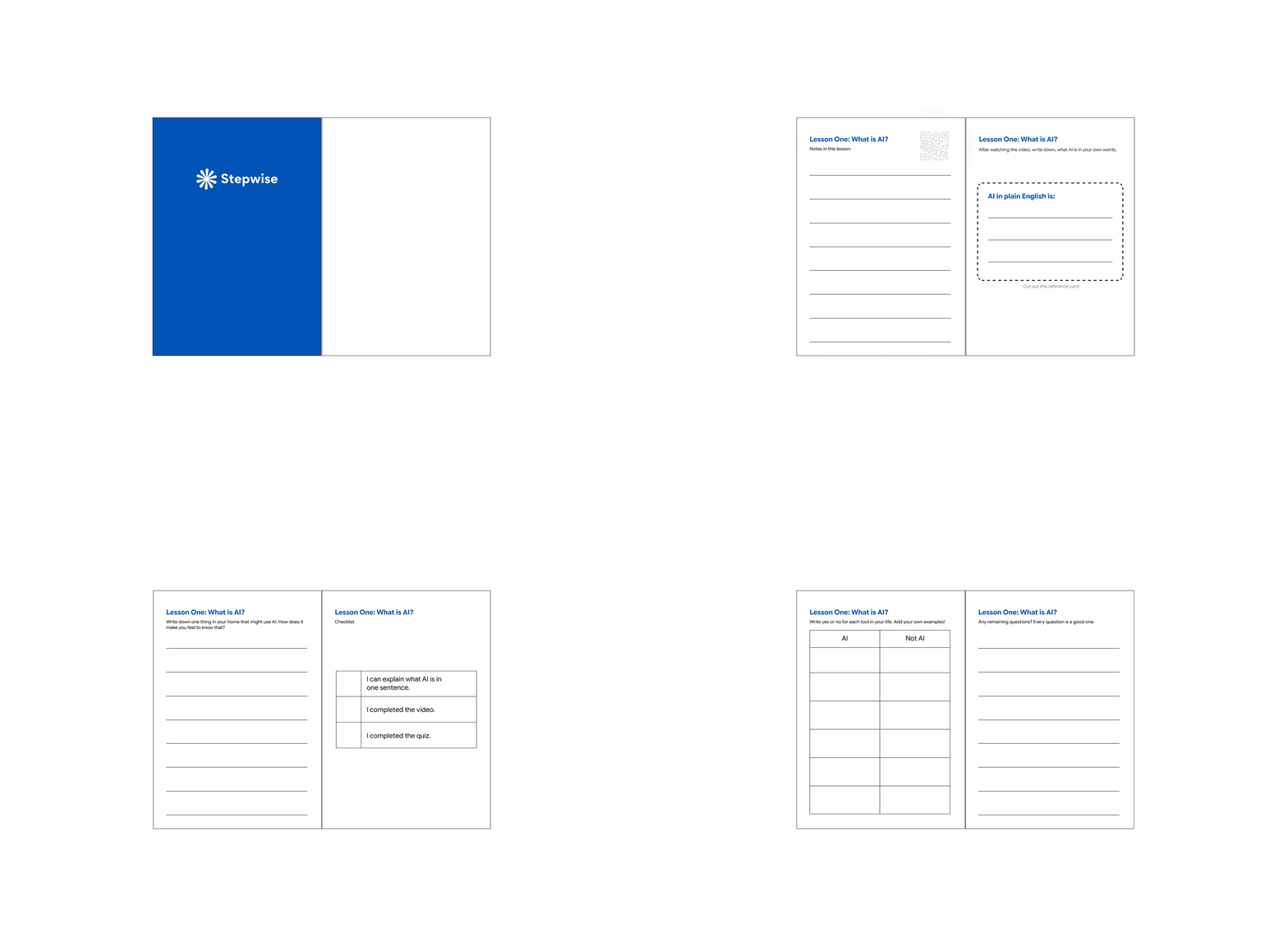
Introducing a physical workbook alongside the app provided a stable anchor for note-taking. To smooth the interaction, the team iterated on "the handshake," creating explicit cues in the workbook that told the user exactly when to pick up the phone and when to set it back down.
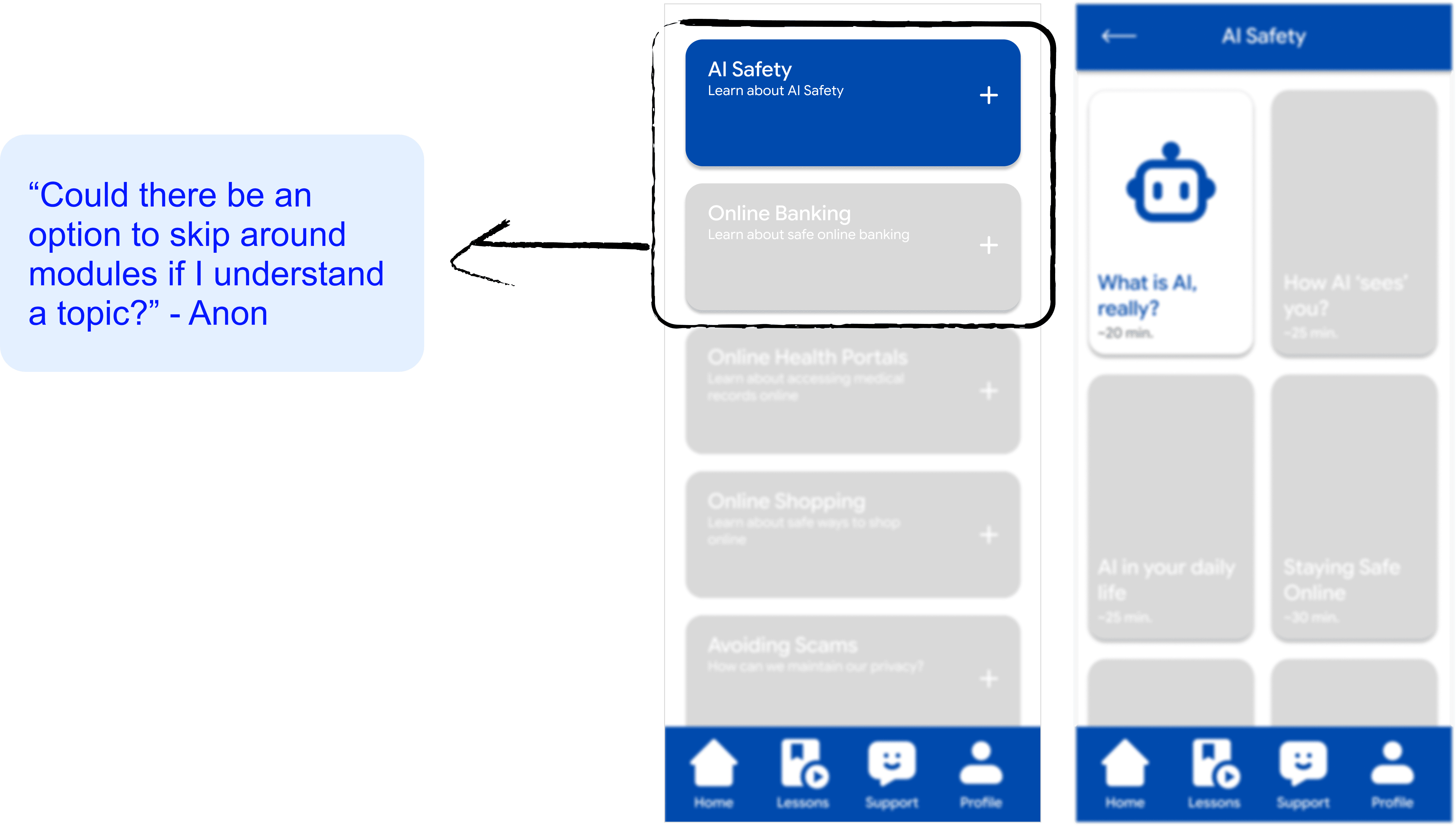
Expanded the system into a robust, structured path that leads directly with AI Safety to address urgent fraud anxieties, implementing interactive changes to fine-tune button sizes and responsiveness.


The Tactile Workbook Anchor and Interactive Handoff
The physical workbook serves as the structural entry point and permanent reference system for the user. Built with a clear cross-modal handoff system, the print layout utilizes explicit visual prompts that coordinate directly with the mobile application, ensuring users never experience digital drift or spatial confusion while transitioning between paper instructions and live mobile screens.
Gamified, Low-Stakes Mobile Learning Interface
Inspired by self-paced language learning applications, the mobile interface breaks complex technical actions into highly visual, bite-sized gamified modules. Built using Framer to optimize interactive friction, the UI expands tap targets, increases button responsiveness, and eliminates hidden menus to accommodate age-related physical and cognitive mobility challenges.
Personalize Your Learning
Additional features include a progress tracker that tracks your goals and visualizes advancement, a workshop calendar connecting learners to in-person experiences in the area, and an AI assistant offering 24/7 personalized guidance—keeping learners motivated, connected, and supported throughout their journey.
USER TESTING
Validation via Community Labs and the Aging in Play Framework
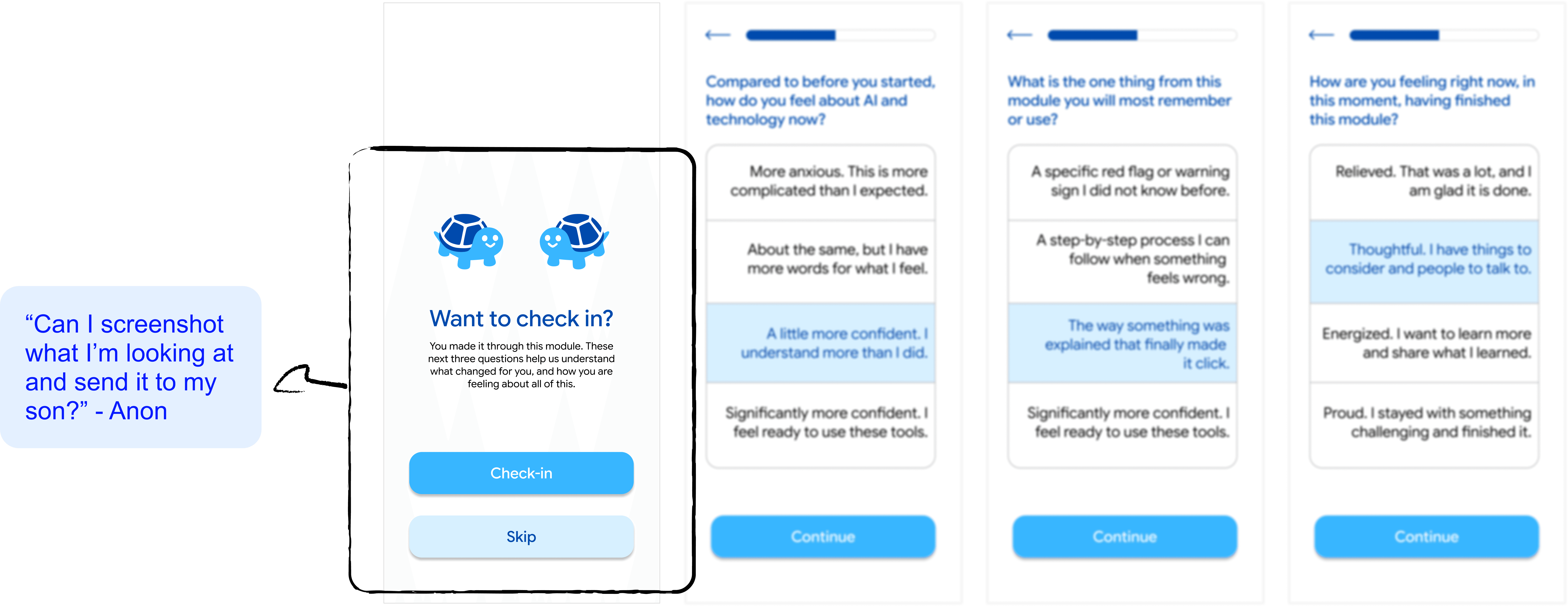
High-fidelity prototypes and full curriculum structures were deployed and validated through testing sessions hosted at Robinhood Foundation's Blue Ridge Labs, Care Festivals, and in collaboration with the Parsons School of Design and the SVA MFA Design for Social Innovation "Aging in Play" research framework. Testing confirmed that the multi-modal format successfully lowered performance anxiety. By introducing interactive friction—such as deliberate confirmation steps and clear victory states—users demonstrated high skill retention and expressed a renewed sense of dignity and playfulness while navigating complex operational tasks.


OUTCOME
A Validated, Measurable Strategy for Sustainable Digital Literacy
The final project delivered a comprehensive, stakeholder-validated opportunity framework and a fully realized 12-week hybrid curriculum consisting of a 4-part module system: Play (Game), Read (Workbook), Watch (Video), and Verify (Quiz). Backed by measurable success metrics—including curriculum completion rates, confidence deltas via pre/post emotional surveys, institutional partner adoption, first license revenue, and self-reported caregiver hours saved—Stepwise establishes a definitive strategic roadmap to transform tech literacy from a reactive, frustrating chore into an empowering, independent human experience.
